Looking back on your career, was there a particular moment that made you realize there were major gaps in access to eye care for vulnerable populations?
It happened gradually, then all at once. Early in my career, I was practising comprehensive ophthalmology at St. Michael's Hospital in downtown Toronto, a hospital that serves a large inner-city population. Through my work there, I began to see firsthand how many patients were falling through the cracks: people experiencing homelessness, individuals with mental health challenges, refugees navigating an unfamiliar system. In 2000, I was asked to help set up an HIV screening clinic, which became a broader general practice and opened my eyes even further to the gaps in care. Then in 2010, I received an Innovation Grant to deliver eye care directly to people who were homeless or marginally housed, and that's where my journey truly began.
Much of your work has focused on bringing ophthalmic care directly into shelters and community settings. What motivated you to take ophthalmology outside of the clinic?
The reality is that most people who are marginally housed do not access healthcare on a regular basis: when they do seek care, it's usually on an emergency basis. So if we wanted to truly understand the visual health status of this population, waiting for them to walk into a clinic wasn't going to work. We had to go to them.
That's exactly what we did. Working with a medical student, I designed our first vision screening study directly inside Toronto's shelter system. We went to ten shelters, randomly selected ten residents by bed number at each site, and assessed their visual status. What we found confirmed what we suspected: rates of visual impairment far exceeding those in the general population, and it laid the foundation for everything that followed.
But beyond the research, there's something about seeing people where they live that changes the dynamic entirely. Patients are more comfortable in their own environment, the interaction feels more human, and the experience becomes more meaningful for everyone — the patients, the students, and myself.
Through your experiences working with homeless populations, refugees, and marginalized communities, what are some realities about healthcare access that many people including trainees may not fully appreciate?
One of the things that strikes me most, after years of doing this work, is how gravely misunderstood people experiencing homelessness are, even within the healthcare system. There's a certain amount of implicit bias at play: assumptions about their personality, their behaviour, how they're going to act in a clinical setting. But my experience has been the opposite. When we go into shelters, we only see people who want their eyes tested. Nobody is forced. They come willingly, they're grateful, and they engage with the care we provide.
That's why I've made it a priority to bring young learners (medical students, in particular) into shelters with me. It shifts something in them. They walk in carrying assumptions they may not even be aware of, and by the time they leave, those assumptions have been challenged. At least, that's what I hope it does.
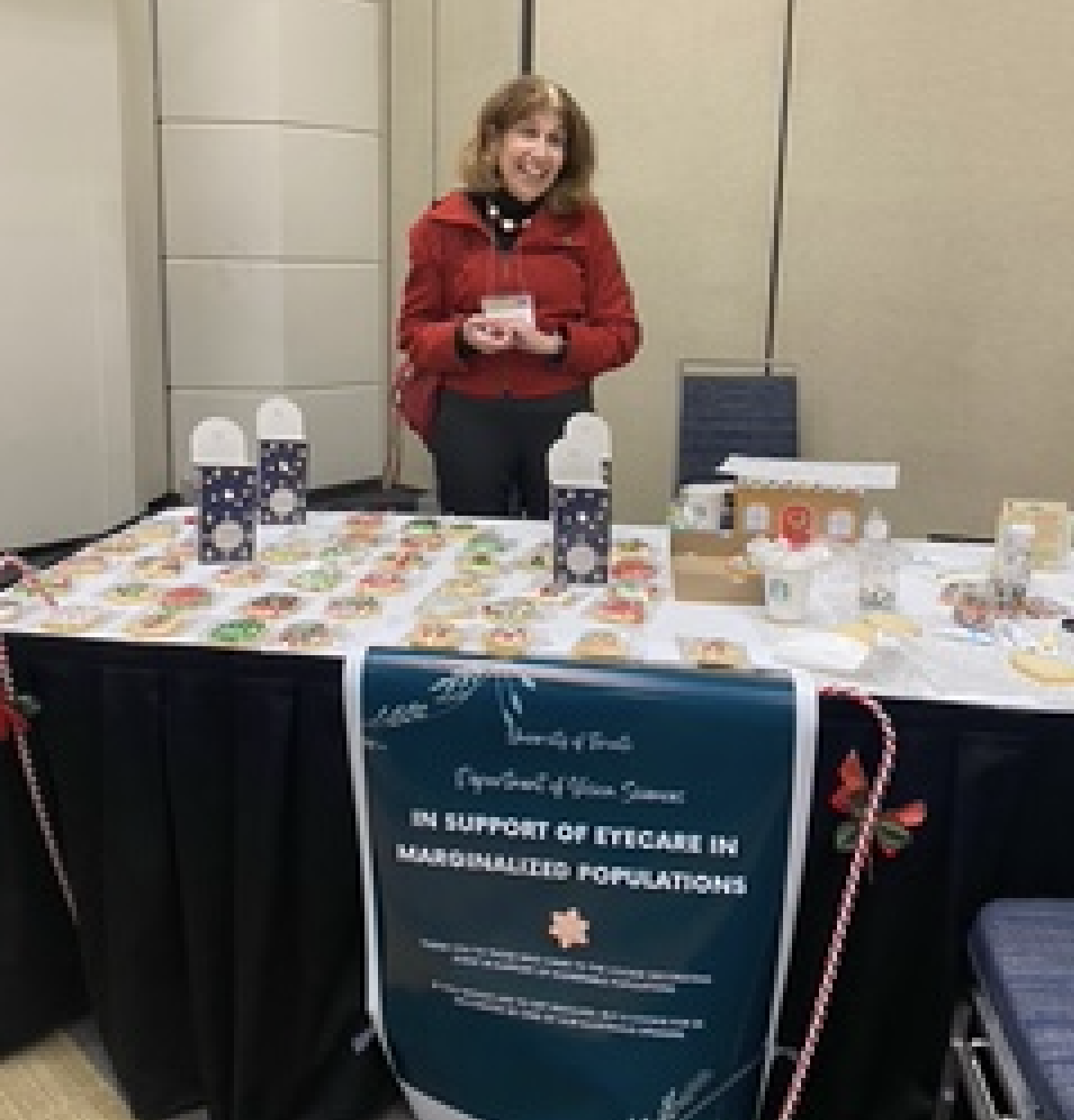
I think of one shelter we visited that serves women who have experienced domestic violence and trafficking. These women were wonderful: warm, open, grateful for any support. We ended up organizing a fundraiser, a cookie drive, to raise funds for them, because most don't stay in shelter very long before transitioning to housing. All they wanted was a hand up to start over. And honestly, that spirit of gratitude was something we encountered across every shelter we worked in.
What are some of the biggest barriers preventing these patients from accessing appropriate eye care in Canada today?
The first thing to understand is that for people experiencing homelessness, eye care is rarely at the top of the list. When you're worrying about where you're going to sleep, whether you have a job, or managing addiction and mental health challenges, your vision becomes a low priority, even when the need is urgent. Through our research in Toronto's shelter system, we found rates of visual impairment about six times higher than in the general population. The need is enormous, but it's competing with everything else.
Then there are the practical barriers that compound the problem. Transportation: how do you get to an appointment when you don't have the means? Language: for newcomers and refugees, navigating the system in an unfamiliar language adds another layer. And cost: in Ontario, if you're on social assistance, you're entitled to one pair of glasses every two years. But holding on to a pair of glasses in a shelter is incredibly difficult. I'd ask patients, "Are those your glasses?" and they'd say, "No, I picked them up." Their own glasses were lost, stolen, or broken, and replacing them wasn't an option. I was fortunate to have grant funding to provide glasses, but access to something as basic as corrective lenses shouldn't depend on a research grant.
And beyond all of that, many people simply don't know where they can go to get a safe, judgment-free eye exam. That's something I want to stress: we need to create safe spaces for underrepresented populations to access care without fear or stigma.
Many of your projects involve students, shelters, volunteers, and multidisciplinary teams. What role does mentorship and community collaboration play in advocacy work?
This kind of work simply can't happen alone: it takes a community. Over the years, I've had the privilege of working with people at every level: medical students, residents, ophthalmologists, optometrists, ophthalmic technicians, and even high school students. Some of our largest projects have been built entirely on that collaborative model. For our Syrian Newcomer Vision Screening Project in 2016, and more recently our Afghan Refugee Vision Screening Project, we assembled teams where medical students took patient histories, high school students ran logistics and coordination, and clinicians performed the examinations. And we never had a shortage of volunteers! There were always people eager to help.
That tells me something important: the desire to get involved is there. Students and trainees want to do this work. The challenge is giving them a way in. The way I see it is that my role, and the role of organizations like COS and the Canadian Association for Public Health and Global Ophthalmology (CAPHGO), is to create a space where students who want to contribute can find the resources, the mentors, and the projects to make it happen.
What do you hope medical students and residents take away from working with vulnerable populations early in their training?
I'll tell you an anecdote. About ten years ago, early in my outreach work, I was invited to speak to ophthalmology residents about community-based eye care. The residents sat there with their arms folded — you can tell when you're not reaching someone. One of them said, "But shelters are dangerous places." I said, "I've been in fifty shelters. I've never once felt in danger. Sometimes a patient is mentally unwell or refuses part of the exam, but you get that in your regular clinic too."
But here's what's encouraging: since that visit, through former residents who carried the work forward, the province where I was invited has developed a very active shelter outreach program. That's the ripple effect of exposure. When you bring people into these settings and let them see patients face to face, attitudes change. And I believe that by giving medical students and residents early exposure to these communities, we can shape the way the next generation of physicians thinks about and cares for people who are homeless.
For students interested in advocacy, public health, or community engagement, what advice would you give them?
The most important thing I want students to know is that you don't have to come to Toronto to do this work. Every community in Canada has people who need help, and often there are physicians doing this work locally who just need to be found. I've had people contact me from Edmonton, Halifax, London looking for a way in; and in many cases, the supervisors and the projects already exist in their own backyard.
That said, one of the gaps I've identified is the lack of a centralized way to connect students with these opportunities. What we're building toward (and this is something I'm very passionate about) is a national portal where students who want to do community health projects can find supervisors and collaborators across the country. There are people doing incredible work already: ophthalmologists running outreach programs in Ottawa, physicians doing children's vision screening in northern Saskatchewan, teams in British Columbia, Alberta, and beyond. My own students often come up with their own project ideas: the key is just giving them the infrastructure and the mentorship to execute them.
One thing I also want to flag for any student considering outreach or research involving Indigenous communities: it's essential to follow the OCAP principles: Ownership, Control, Access, and Possession. These are ethical guidelines that ensure any research conducted with Indigenous populations is done in genuine partnership with the community. That means having an Indigenous collaborator, ensuring the community has ownership over the data, and approaching the work with respect for the protocols that are in place. Indigenous shelters have always been a significant part of our work, and it has to be done the right way.
If you could instantly change one thing in Canadian ophthalmology, what would it be?
I thought about this question a lot. Ophthalmology tends to be a very high-volume practice, and we often justify that pace as necessary to meet demand. But high volume can come at a cost to the human side of what we do. People have backstories, people have lives: we're not machines treating patients. If I could change one thing, it would be this: put the care back in healthcare. Most doctors are caring people — that's why they entered the profession — but especially for our most marginalized populations, we need to go a step further. They don't have the support networks to help them navigate the system, so we have to provide a little more time, a little more patience, and more resources to bridge that gap.
I'll leave you with this: recently, at one of our Out of the Cold programs (where we provide eye care in a church basement for people living on the street) someone came up to me and said, "Last year, you gave this man a pair of glasses. After that, he went out, got a haircut, got some new clothes, and he's working now. His life has turned around." You may not change life for everybody, but you can make life a little better.